Aquablation in Orange County:
the robotic, heat-free waterjet
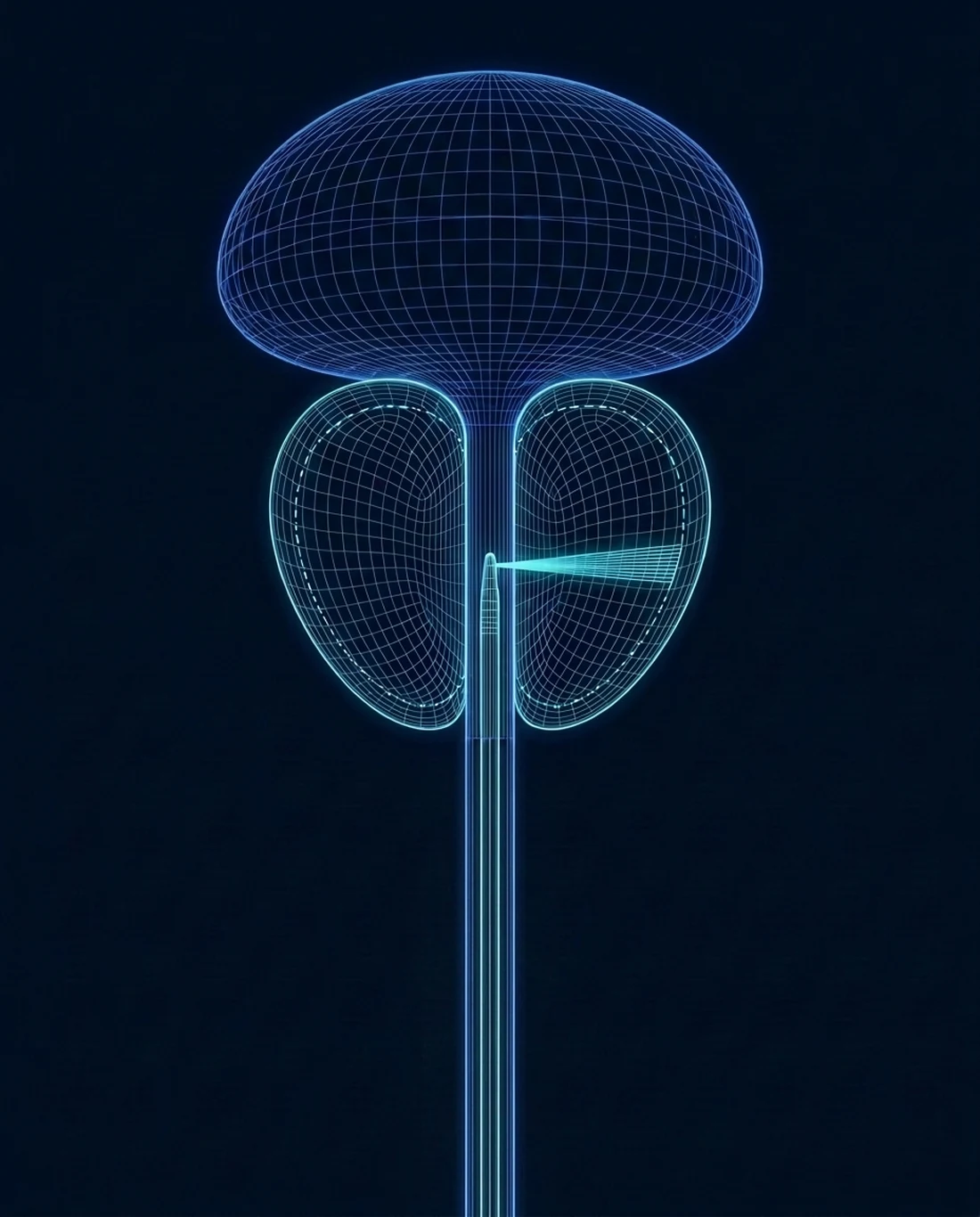
Aquablation removes the obstructing prostate tissue with a robotically controlled, heat-free saline waterjet, guided by real-time ultrasound. A precise, consistent option that works across the full range of prostate sizes. Dr. Sawkar has performed more than 250 Aquablation procedures at Providence St. Joseph Hospital, the highest volume of any surgeon in Orange County.
Medically reviewed by Hari Sawkar, MD, board-certified urologist · Updated October 2026
How Aquablation works
Aquablation pairs real-time ultrasound imaging with a computer-controlled robotic arm to map and remove the obstructing prostate tissue using a high-velocity saline waterjet. Because the waterjet uses no heat, the risk of thermal injury to the surrounding nerves and sphincters is minimized.
The robotic system carries out the plan with sub-millimeter accuracy every time, regardless of prostate size or complexity, which makes it especially well suited to large or complex prostates. Dr. Sawkar has performed more than 250 Aquablation procedures, the highest volume of any surgeon in Orange County and among the highest on the West Coast.
Anesthesia
The procedure is done in the hospital under spinal or general anesthesia, typically with one night's stay.
Ultrasound mapping
A transrectal ultrasound builds a 3D map of the prostate, defining exactly which tissue to remove.
Waterjet resection
A heat-free saline waterjet removes the planned tissue with robotic, sub-millimeter precision.
Recovery
A catheter stays in for a day or two. Most men return to normal activities within one to two weeks.
Why men choose Aquablation
Works for any prostate size
Proven for small, medium, and large prostates, including complex anatomies that challenge other approaches.
Heat-free technology
No thermal energy means no heat-related damage to the nerves, sphincters, and structures around the prostate.
Robotic precision
Computer-controlled delivery removes exactly the planned tissue, for consistent results case after case.
250+ procedures and counting
The highest Aquablation volume of any surgeon in Orange County, and among the highest on the West Coast.
Is Aquablation right for you
Aquablation is the surgical-grade option of the four: real tissue removal, one time, with the robot protecting what matters. It fits a specific patient, and imaging confirms the fit first.
Almost any size or shape
Proven from 30 to 150 cc, including large glands and median lobes that rule out the office procedures entirely.
You want one-and-done durability
Tissue is physically removed, so the result is the most definitive of the minimally invasive options, with retreatment uncommon.
Function still matters to you
The heat-free waterjet and robotic planning were designed to spare the structures responsible for continence and ejaculation.
A night in the hospital is acceptable
Spinal or general anesthesia, typically one overnight stay, and a catheter for a day or two. Men who want to avoid the OR entirely usually look at PAE.
Because Dr. Sawkar offers Aquablation alongside PAE, UroLift, and Rezūm, the recommendation follows your measured anatomy and your goals, not the nearest machine. Whichever page brought you here, the consultation starts from the full menu.
What the evidence shows
Aquablation was tested the hard way: head-to-head against TURP, the century-old surgical benchmark, in the randomized WATER trial, with a companion WATER II study dedicated to large 80 to 150 cc glands.
TURP-grade relief
Symptom relief matched the surgical gold standard, and in larger prostates Aquablation outperformed, precisely where traditional surgery gets hardest.
Function protected
Rates of ejaculatory dysfunction were several-fold lower than TURP's, the result of heat-free resection and robotic planning that spares key structures.
Experience compounds
Outcomes track with surgical planning, and planning improves with volume. With more than 250 cases, Dr. Sawkar holds the highest Aquablation volume in Orange County, among the highest on the West Coast.
Risks, downsides and success rate, honestly
Every real treatment has a real downside, and a surgeon 250 cases in has seen each of these. The success side first: in the randomized WATER trial, symptom scores fell by roughly 15 points and stayed there through five years, about 1 in 20 men needed a repeat surgical procedure in that time, similar to TURP, and the need for any further BPH treatment, medication or surgery, was about half that after TURP. Here is the other side of the ledger.
Bleeding
The most discussed downside. Blood in the urine for one to three weeks is expected. Bleeding heavy enough to need a transfusion ran a few percent in the early large-prostate series and is uncommon now that the resection bed is cauterized at the end of the procedure.
Ejaculation
About 1 in 10 men in the trial lost ejaculation, versus roughly 1 in 3 after TURP. The heat-free waterjet and a plan that spares the ejaculatory ducts are why the number is low; it is not zero.
Erections
No meaningful change on average in the trials. Men who arrive with erectile trouble usually leave with the same erectile trouble, no better and no worse, and men with good function keep it.
Leakage
Urgency and small leaks are common in the first weeks while the resection surface heals and typically settle by three months. Persistent stress incontinence is rare, in the low single digits or less.
The catheter
Most men have it out in a day or two. A minority need it for several more days, usually men with very large glands or a weak bladder going in; it comes out once you are emptying well.
The rest of the list
Urinary infection, a scar narrowing the urethra or bladder neck that needs a minor procedure (a few percent), and the risks of anesthesia and a hospital night. Men who cannot pause blood thinners, or whose prostate exceeds about 150 cc, usually look at PAE instead.
If you have searched for Aquablation problems or complications, this is the list. Nothing here is hidden at the consultation either; the point of a candid conversation is that you choose with the whole picture. The Aquablation side effects and success rate page has the full detail, including how often each one happens.
Recovery, in plain terms
Expect one night in the hospital and a catheter for a day or two. Some blood in the urine during the first days is normal and clears. Desk work resumes within about a week for most men, with heavy lifting and hard exercise on hold for two to four weeks while the prostate heals from the inside. Flow improvement is typically obvious as soon as the catheter comes out, and it is durable, because the obstructing tissue is gone rather than pushed aside or shrunk. The full timeline, week by week, is on the Aquablation recovery page.
Aquablation vs the alternatives
Dr. Sawkar performs Aquablation, UroLift, and Rezūm himself and leads PAE care, so the comparison below has no thumb on the scale; TURP and HoLEP stay on the table when they are the better call. Each row links to the full comparison.
| Compared with | Setting | Where Aquablation wins | Where the other wins | Read |
|---|---|---|---|---|
| TURP | Hospital, one night | Same relief with several-fold less ejaculatory loss; consistent in large glands | A century of track record; no robot required | Aquablation vs TURP |
| HoLEP | Hospital, one night | Shorter operation, no laser heat, gentler on ejaculation | Removes more tissue in glands well over 150 cc | Aquablation vs HoLEP |
| UroLift | Office visit | Larger, more durable relief; no implants; any size to 150 cc | No catheter, back to work in days, the surest bet on ejaculation | Aquablation vs UroLift |
| Rezūm | Office visit | Result evident once the catheter is out; works above 80 cc | No hospital, local anesthesia, a strong five-year record in small to medium glands | The office options compared |
| PAE | Outpatient lab | The most definitive single treatment; result evident in days | No catheter, no hospital, blood thinners continued, no size ceiling | PAE vs Aquablation |
Costs and recovery have their own pages: Aquablation cost and coverage, Aquablation recovery week by week, and the four alternatives to TURP.
Common questions about Aquablation
Is Aquablation real surgery
Yes. It is a hospital procedure under spinal or general anesthesia in which obstructing tissue is physically removed. What sets it apart from traditional surgery is how: a heat-free waterjet executing a robotic plan built from live ultrasound, designed to protect continence and sexual function.
How is Aquablation different from TURP
In the randomized WATER trial, symptom relief matched TURP while ejaculatory dysfunction was several-fold lower. The robot also makes results consistent across prostate sizes and shapes, including large glands where TURP becomes slow and less complete.
Is my prostate too large for Aquablation
Rarely. It is proven from 30 to 150 cc, a wider range than almost any other option. Beyond roughly 150 cc, PAE, which has no practical size ceiling, usually enters the conversation, and Dr. Sawkar offers both.
Will it affect ejaculation or erections
Far less than traditional surgery. Heat-free resection and robotic planning spare the structures involved, and most men preserve ejaculation, a several-fold improvement over TURP in trial data. Erections are typically unaffected.
Does the surgeon's volume matter
Yes. The robot executes the plan, but the surgeon builds it, and planning judgment comes from repetition. Dr. Sawkar has performed more than 250 Aquablation procedures at Providence St. Joseph Hospital, the highest volume in Orange County and among the highest on the West Coast.
Who performs Aquablation in Orange County
Dr. Hari Sawkar, board-certified urologist and Chief of Urology at Providence St. Joseph Hospital, performs Aquablation there, with more than 250 procedures, the highest volume in Orange County. Consultations run through his Tustin office, with same-day and next-day appointments available.
What are the downsides of Aquablation
A hospital procedure under anesthesia with a night's stay, a catheter for a day or two, blood in the urine for a few weeks, and a small chance of bleeding that needs treatment. About 1 in 10 men lose ejaculation, far fewer than after TURP. Men who cannot stop blood thinners or have a prostate over about 150 cc usually look at PAE instead.
What is the success rate of Aquablation
In the randomized WATER trial, symptom scores improved by about 15 points and held through five years. About 1 in 20 men needed a repeat surgical procedure in that time, similar to TURP, and the need for any further BPH treatment, medication or surgery, was about half that after TURP. Results in large glands of 80 to 150 cc were as strong in the companion WATER II study.
Does Medicare cover Aquablation
Yes. Medicare covers Aquablation on the same medical-necessity basis as TURP, and most PPO and commercial plans follow. Your share depends on your plan's structure, and the office verifies coverage before anything is scheduled. The cost page walks through each situation.
How much does Aquablation cost
With Original Medicare, expect the $283 Part B deductible if it is not yet met, then 20 percent of the Medicare-allowed amount for the surgeon and anesthesia, with the hospital share under Part A or Part B depending on how the stay is classified. A Medigap supplement usually absorbs the coinsurance. PPO plans apply their deductible and coinsurance, and self-pay patients get one bundled quote.

See if Aquablation is right for you
Same-day and next-day appointments. Aquablation is typically covered by Medicare and most commercial plans, with telehealth consultations available. For the fastest response, send the office a secure message; the reply comes back by text.
Chief of Urology, Providence St. Joseph Hospital · UroLift Center of Excellence · Orange County's highest-volume Aquablation surgeon